

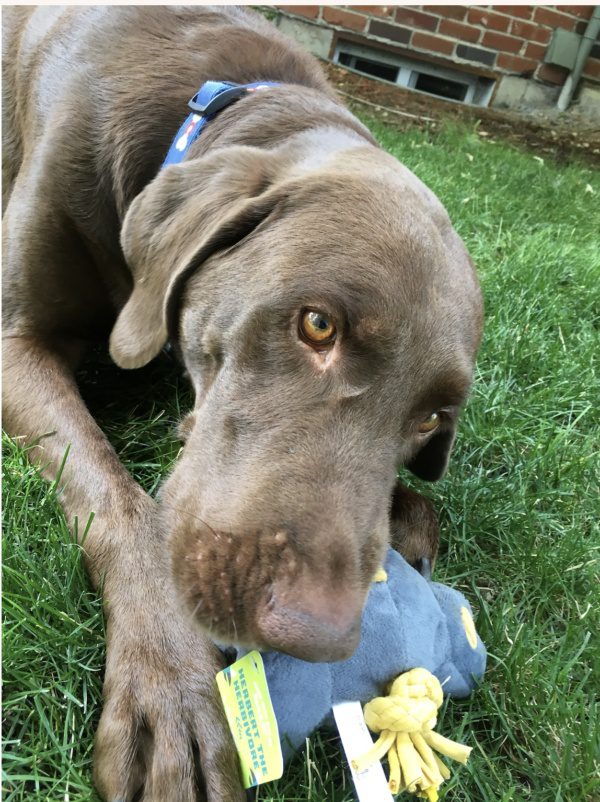
A reenactment of the chipmunk massacre, this time with a stuffed toy.
We adopted Mason when he was eleven months old; a fully-grown lab and Weimaraner mix, he supposedly chewed up a car seat in his former home before ending up in ours. I felt offended on behalf of him, a puppy who was simply following his nose to suss out errant granola bar crumbs.
When his foster rescue mom brought him over, we let him out in the backyard, and he immediately caught a chipmunk. Our other dog, Jessie, was blind and so old, the chipmunks could’ve run up and down her spine and she wouldn’t have minded.
Confused, Mason looked at us, limp rodent hanging from his mouth. What now? “Let it go, Mason,” his foster mom yelled, and he did. The wounded critter somehow slithered under the fence, but the warning shot had been fired: There’s a new sheriff in town.
A blend of happy-go-lucky chocolate lab and neurotic Weimaraner, Mason spent the first decade of his life in motion, usually in pursuit of a tennis ball flung off our lime green Chukit!. At the dog park, he had no interest in sniffing the butts of other canines; his singular, impressive focus was fetching a slobbery ball coated in gravel and dropping it at my feet. Again. And again. And again.
Our backyard wasn’t big enough to wear him out, so the kids and I invented an elaborate game called Chuckit to Racket to Teeth: a tennis ball launched from the Chuckit! to a tennis racket, then ideally landing right in Mason’s mouth. The success rate was less than 10%, but when we pulled it off, it was magic.
These days, Mason is 13.5 years old (95ish in human years?), and everything about him has slowed down. His back legs have lost their strength, and watching him struggle to stand makes my own body ache. He doesn’t really walk anymore—it’s more of a lurching teeter. Still, he rallies when it counts: whenever he hears the vegetable drawer slide open (baby carrots are his favorite) or the crack of a banana peel (a close second), he’s there.
This morning, he had a seizure: a big one, complete with loss of his bowels and eyes rolling around. I’ve had plenty of dog emergencies, but never dealt with a seizure before. I wasn’t home for it, but if you’ve ever watched a pet age, you know how it breaks your heart wide open.
Mason is how I mark my days. At 5:45 a.m., he’s ready for breakfast—even though the dog diner doesn’t open until 7. While I wait for my tea water to boil, he lets me bury my face in his furry neck. Then I tell him, about 17 times, how handsome he is before asking him what’s on his Google Calendar for the day. (Yes, my daily question drives my kids nuts. But I can’t stop myself.)
Turns out, the main items on his schedule never change: eat, nap, go outside, offer joy and unconditional love to anyone who needs it.
He’s my longest-running and most loyal coworker—and the canine with the most cameos in AMR videos. He spends most of his day beside me in my office. His dinner arrives around 3:30, and at our dinner a few hours later, Grant eats with one hand and pets Mason with the other. Then it’s one treat, and one medication I call Super Advil. By 8:15, he’s ready for his last pee and bedtime. So am I. He pants as he lumbers up the stairs, and I’m not far behind.
This morning, when I got home, Mason was as spry as a 95-year-old human might be after a seizure—alert but weary. He was ready for the next item on his calendar: a long nap. But he smelled a bit ripe, so I set up for an outdoor bath: hose, towels, dog shampoo and conditioner.
I wet him down and gently lathered him up, my hands tracing the hard lumps and soft bumps that have multiplied with age. Looking into his cloudy eyes, I reminded him—again—how good and handsome he is. A quick search for “seizure in 13-year-old dog” turned up what I already feared: it could mean nothing, or it could mean the end. He might have two more weeks, or two more years. Either way, the goodbye will ruin me.
I skipped washing his head—his day had already been hard enough—but I spent extra time on his back legs, giving them a gentle massage and thorough rinse.
I wanted to be fast—he hates cold water and his toothpick legs were shaking—but I also wanted to slow it all down. To let him feel how much he is loved. To show him that we will care for him for as long as it makes sense. That we don’t expect him to live forever.
Like most dogs, he lives only in the present. The bath? Already a distant memory. Probably the seizure too. He’ll wake up tomorrow morning, hopeful that breakfast might arrive early. After all, it’s what’s on his Google Calendar.



Lovely. It’s so hard watching our furry family members get old. They give us so much. Hugs to you and your family, Dimity. And belly rubs and neck snuggles to Mason.
💔
I feel every ounce of your love and you made me cry as I read this while waiting for my computer to power up at work. Beautiful – I’m going to go home tonight and snuggle with my furbaby and remind him how handsome he is❤️
Oh, he’s VERY, VERY handsome. :)
Beautiful tribute to Mason. I have An aging Golden named Murphy and have been living on him so much to coax out a few more days, weeks or years. What ever I can Get will not be long enough . I think We love dogs so much because we know the time is precious and limited. Carry on Mason and be well Dimitri
I agree: dogs live so fully and easily in a condensed period of time. They’re just the best.
1/17/2010 – 5/12/2025
Just yesterday, we euthanized our 15 years and 4 month old black lab. The tragic news of a splenic mass (wherein its rupture would mean certain suffering and death) had come only one week prior after only one bad day of immobility issues.
We took “Bruce” to his favorite places : our beach spot, our local lake, our neighborhood.
We gave him his favorite treats. He FaceTimed his favorite humans… all the way up until our appt.
Tom (my 23 year old son) and I laid on the blanket beside him. We pet him and thanked him for being all of our best friends.
And he peacefully slipped away…
It was an astonishingly beautiful experience for our beloved friend. Now it’s us left with this massive void and pain. Everywhere in our home reminds me of him. I delight in finding his fur. Sleeping has taken on a new agony without his peaceful breathing and warm soft furry body beside me.
We don’t deserve dogs.
“I wanted to spend the rest of my life with Bruce. But instead I am deeply honored to have spent the rest of his life with me.”
Brittany Moore so aptly described this in her heart wrenching song “Give A Girl.” Have tissues ready.
I hope you have many many more days before you experience this part of the enduring love of a beloved canine.
❤️❤️❤️
Amy, I’m so sorry for your loss. It’s so hard.
Thank you so much. In my grief, I’m trying so very hard to focus on the truth that our Bruce (he raised 3 kids!) enjoyed a fabulous life all 15+ years.
Oh Amy, so sorry to hear about Bruce. So glad he got to the beach, the lake, and to be surrounded by his people. Hope it gets a little easier. xo
Thank you, Dimity. The timing of your masterful tribute was uncanny. Our doggie stories are similar. I’m sure you will treasure your sweetheart for as long as you can. How blessed are we?
Dimity, This is such a lovely piece of writing. Thank you for sharing. THIS is what we come to AMR for! Communion. xoxo
Thank you, Tish! xo
I have to say, Mason’s cameos on a strength circuit video was the moment that started me on the path to getting my first pet (Pepper)! Not having any experience with having a pet ever in my life yet (I was entering my 40’s), it came as a surprise to me to think “I think I want to get a dog”! Now we have Pepper who is going on 5 years old and I can’t imagine life without her! So give that Mason an extra kiss and a thank you from us❤️
Dimity, I have loved reading all things Mason since he was a pup and we were both in our early 40s. And you gave me an all-knowing nod when you learned I had a Vizsla named Henry. I am so very thankful to have Henry in my life (he’s six now, just a lovely middle-aged gentleman with a touch of neuroses). I also feel so blessed to know other women who love their dogs as fiercely as I do. And I know you are one of them. Please feel our many hands on your back as you progress thru these next stages with Mason. We are all here in the background supporting you.
Oh my goodness, this made me tear up. Our current best ever doggos are 11 and 9, and watching them slow down is so very hard. Sending big hugs to Mason and saying prayers that we all remember how precious the time we get with ours pups really is. ❤️
It is a love that cuts so deep, and there is only one Mason. You so beautifully captured that special relationship and reminders how best to navigate the last chapter of it.