
In our first installment of the AMR Traveling TriggerPoint Ultimate 6 Kit, we tackled Plantar Fasciitis. In this round, Denise Dollar, a 46-year-old mother runner with two kids, gets some relief for her Iliotibial Band Syndrome (ITBS).
What IT Band Syndrome is: ITBS is a running-induced injury that is best described as pain in the outside of the knee. Not a muscle, but rather thick fascia, the Iliotibial Band extends from the outside of the hip to below the knee, and as such, it’s a vital player in the functioning of those of those joints. The IT Band helps flex, extend, and stabilize your knee during foot strike, and those responsibilities, combined with continual rubbing across the across the bottom corner of your femur, can cause it to become inflamed.
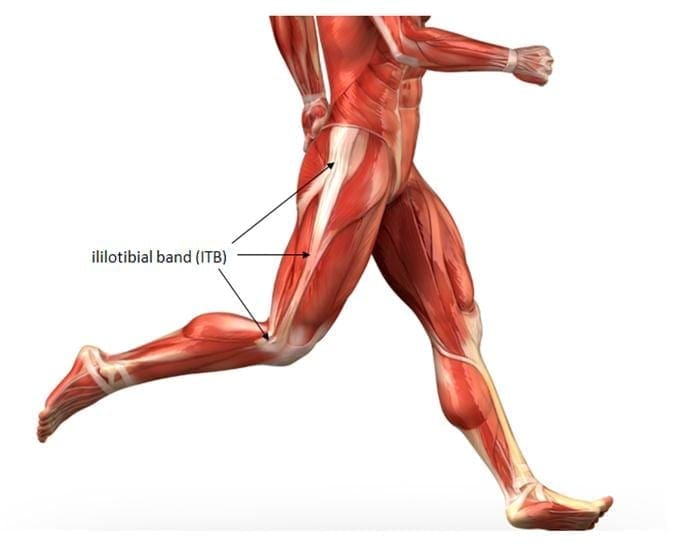
Hello, muscular runner man. What a nice IT Band you have.
On a scale of 1 (a hangnail) to 10 (hospitalization required), I would rate this injury as an: 8. It stopped me dead in my tracks around mile seven of my first half-marathon. After that, I felt mentally blocked and had a hard time asking for help and moving forward at all with running.
What causes it: Because the IT Band runs extends from above your hip to below your knee, IT Band Syndrome can have a variety of causes; thank you, muscular kinetic chain, in which everything from your toe tendons to your abs is somehow connected. Hips that are both tight and weak, a common occurrence among female runners, can definitely contribute. Typical training errors—running too much too soon, doing too many intense workouts, letting your form lapse on long runs, running on continually on roads with a severe cant—can also play a part. Running in shoes that aren’t right for you may also cause your IT Band to bark. (More causes? Watch this TriggerPoint flick: Misconceptions of IT Bands.)
I didn’t stretch my hips or any part of my lower body, really. I didn’t have the right shoes, and looking back, I didn’t have a solid foundation from which to train for a half-marathon. I ran too much too soon.
What it feels like physically: It’s like someone is stabbing a knife into the outside of my knee; the pain is so intense, it’s hard to put any pressure on the leg. It typically flares up around mile 6 or 7 into a run. The good news is that I’ve never noticed it when I’m not running.
You might have it if: You have an imaginary knife going through the outside of your knee. (Although the IT Band is a long band of fascia, the pain usually materializes at the knee.) Initially, it only hurts when you are running, and although the spot around your knee may be tender, there’s usually minimal swelling involved. Runner’s World says, “The best way to tell if you have ITBS is to bend your knee at a 45-degree angle. If you have an IT band problem, you’ll feel pain on the outside of the knee.”
What and how to roll: I rolled 10-15 minutes every day, regardless if I ran. I always rolled before running and tried to get to it after as well. Twice a week, I rolled for 30 minutes. (I really want to kick ITBS to the curb!) I really liked the piriformis moves with the massage ball; releasing my glutes seems to gently ask my IT Band to loosen up a bit. I used a more gentle roller directly on my IT Band, which can bring tears to my eyes but ultimately brings relief.
What else works physically: Yoga has helped me immensely (here’s a routine focused on the IT band: . In particular, I love the pigeon pose, which my physical therapist recommends.
How I coped mentally: It took me a while to get back to running after my first half-marathon. After my second half, when I was still struggling with my IT Band issues, I took a break from longer distances while I trained for a century [100-mile bike ride]. I was still running, but I was going shorter distances and thankfully, I wasn’t having any pain.
But I wanted to get back to running longer distances and had a hard time getting past that mental block, continuing to think of mile 6-7 as painful. Once I was armed with help and stretches from my PT and the knowledge that I had to take care of my IT Band regularly in order to keep going strong, I felt better about tackling longer runs. With additional therapy work with the Ultimate 6 kit, I got past the 6-7 mile mark without pain and I now feel more confident. I really had to learn—and, honestly, I continue to learn—about what running is for me, how to listen to my body and to address issues when they come up and not let them derail me, mentally or physically.
How I’ll avoid it in the future: Releasing and stretching the muscles in and around the IT Band, espeically the hips and the piriformis, is the biggest conduit for a comfortable run. Strengthening them is huge too; here are some exercises that’ll keep you solid and stable. Taking a few days off when I feel it flaring up—instead of trying to run through it—can also reset it.
Anything we missed? How did you cope, both mentally and physically, with a bout of IT Band Syndrome that is (fingers crossed) in your past?
And do you have an injury that could benefit from the AMR Traveling Ultimate 6 Kit? Email us at runmother [at] gmail [dot] com and we’ll see if the Kit can make a stop at your mother runner house. (We have received a bunch of entries, and are slowly combing through them, so if you have already emailed us, we’ll be in touch asap.)

Ice in Dixie cups & deep tissue manipulation at the physical therapist. Standard stretches while running & a lot if praying. I’ve had it issues for almost 10 years! Showed up on the Air Force half marathon. All but killed me at mike 20 of the rock n roll marathon. Literally felt like someone was stabbing me in my right knee. I’m training for the marine corps marathon so I may have to try this to make it through!!
Clam shell leg stretches and foam rolling help. I sometimes feel IT band pain in my hip or the outside of the knee if I do my long run on a road that is sloped – I try to swap sides of the road every mile (with and against traffic) to keep from running too long on one side. That really helps prevent the flare up.
I had severe pain right over the top of my iliac crest. My Chiropractor suggested told me that though ITBS normally manifests in the knee it sometimes will show up in the hip – especially in women. Sure enough, the stretching and rolling for ITBS cleared up my hip problems.
Physically, stretching and foam rolling have been my go-to ways to keep it from being too angry. Recently I have added strengthening exercises for my hip flexors and glutes and that seems to be helping a lot. Mentally, if it flares up during a run, I’ve been known to (silently) direct some strong cuss words at it.
Thank you Dimity and Sarah for the opportunity,and thank you to Trigger Point for helping me tackle my ITBS. Good luck to the next recipient, cheers!
As an aging runner (59) with two half-marathons quickly approaching and a hilly marathon coming up in the fall, I am currently dealing with osteoarthritis in the knee and working with a pt to strengthen and stretch. Not accustomed to injury, I could use all the help I can get!
Graston Technique done by my physical therapist. YIKES!! OUCH. Stretching 4 times a day and especially after ever a run. Briskly walking for 5 minutes before a run starts. The right shoes. The pain was better in days!
Hamstrings, hamstrings, hamstrings – I’m sure it comes from tight hips, but they are my biggest issue.
Good job, Denise:)
Such a timely post… I am dealing with an angry piriformis muscle that is causing sciatic nerve pain. Hoping it doesn’t stop me from running my 10k race on Saturday. I’ve also had ITB issues and foam rolling is pretty much the only thing that helps. I just got “the stick” and I also love it but nothing beats the foam roller. Interestingly my ITB pain only ever happened when I would lay down to sleep (I’m a side sleeper); needless to say no sleep = a grumpy person. After a year of struggling I finally kicked and am in a good place (I still foam roll). I’m guessing my angry piriformis is related to my ITB issues… bring on the hip strengthening and stretching!
Strengthening the IT Band and the muscles that it connects to was the key to my healing from a four year long bout of IT Band pain. The best strengthening exercise is the “Frankenstein Marching Band”.
I had my first IT flare up running my 1st marathon in Nov last year. I have been working on strengthening with exercises and yoga. Have yet to be pain free but things are moving in a better direction and I would love to try using this kit as I haven’t used a roller. Just ran my 2nd marathon April 12th and want to kick this IT issues to the curb for my next half coming up in June. Great demo video by my cousin and mother runner Denise!
Leah you have been a machine inspiring our entire family! and thank you for watching ;)
Weakness through the glutes and/or hip flexors (super common in women runners) can contribute to ITBS, so It is really important to not only stretch but to strengthen correctly to completely kick it to the curb (believes this ortho PT!)
OMG!! this sounds like exactly what I need! ITB issues just caused me to halt my training for my first Full Marathon (I am still going to run the Half) and at this point I struggle to get beyond 6-7 miles without pain. My PT laughs because I have actually named my Foam roller (why shouldn’t my new best friend have a name?) and I rendezvous with Sir Felix virtually every day!
I just like the valuable info you provide on yoiur articles.
I will bookmark your weblog and check again right hsre regularly.
I’m reasonably certain I’ll be told many nnew stuff proper right here!
Good luck for the next!
Take a look at my homepage; video email
You can have a photography conttest based on your company’s mission.
But you already stand before this mind even arises.
” Exercise has been shown to not only reduce weight and improve health but also improve cognitive function.
My web blog – Focus Supplement
When we read, we don’t think about the
process itself. However, don’t forget that you tend to gget anything youu pay for.
Gingko biloba, one of the key ingredients used
for the prreparation of ayurvedic medicines is a safe herbal remedy to imnprove memory power of your brain.
My webpage – Concentration And Focus
Some I did secretly, under a blanket on the airplane and in the
hospital; others I did in the open. Electric cigarettes or electric cigarettes, are
the newest products in the quit-smoking industry.
V2 Cigs, Ever – Smoke Cigarette, Smoke – Stik Electronic Cigarette and many other brands are famous in this regard.
The product appears like a real cigarette but does not work
like a genuine cigarette. It can be so light to support in between your fingers with this particular new
style as well. You can use them in trains, planes, pubs, office, restaurants and anywhere else.