

If you caught our Holiday Gift Guide, you would have spotted the book Epic Runs of North America. Over on the AMR Podcast today, we’re chatting with travel writer Allison Torres Burtka, who is sharing her essay from the book all about running in White Sands National Park.
I’ve just walked up a steep, bright dune with my family, at White Sands National Park. At the top, it looks as if the rolling dunes go on forever. We’re in New Mexico’s Chihuahuan Desert, where the sand is so white it looks otherworldly, but inviting all the same.
We’ve got running shoes on, but we’re not yet sure how runnable the surface is going to be. Loose sand can be frustrating and a park ranger we spoke to seemed to think that running on the dunes wouldn’t exactly be fun. But my husband and I, along with our kids (a teen and a tween who run cross-country and track) like to run on trails. So, we decide to see how it goes.
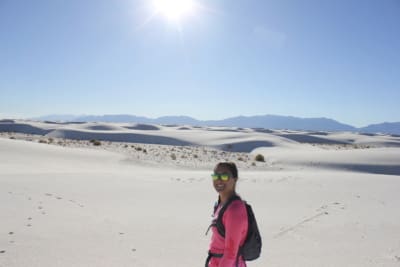
The bright, white gypsum dunes at this national park are like nowhere else on Earth
We take off and the sand feels relatively solid under our feet. More compacted than it first appears, it doesn’t feel at all like we’re sinking, or churning up the terrain with every step. My kids increase to full speed, down the first hill and up another, until everybody’s excited by just how unique this gorgeous landscape is. Traveling across dunes and ridges, sun shining all the while, it’s exhilarating.
Unlike most sand, which is primarily quartz, the sand here is so much whiter because it’s gypsum. White Sands is part of a 275 sq mile (712 sq km) gypsum dune field, the largest in the world. Which is, perhaps, why it feels like no place I’ve ever been.
Formerly a national monument, it became a national park in 2019. In the middle of our run, we stop for a water break and to admire the natural wonder around us. Beyond the dunes, the San Andres and the Sacramento Mountains look almost purple. We kneel down to touch the sand and notice it feels different from beach sand. It’s cool, even though the sun is strong, and it doesn’t stick to our skin and clothes like regular sand; I learn later that gypsum sand dissolves in water.
We start running again and the sound of our feet striking the sand is satisfying. At the top of the dunes, all we can see in every direction are more crisp, white dunes and, here and there, mountains in the distance. In some spots, the sand is dotted with short plants that must be especially hardy.
The route we’re on is the Backcountry Camping Loop Trail although, technically, it’s not so much a trail as a series of numbered posts to guide you around the dunes. Which seems kind of obvious, given the shifting sand prevents any trail from being maintained. We find that this is part of the adventure, trying to tell where the next post is and whether we’re headed in the right direction.
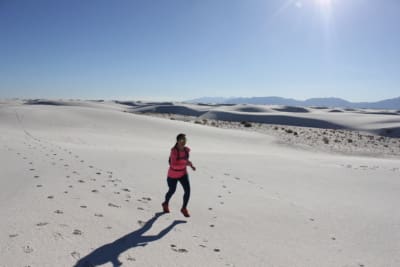
Allison on the “trail” of gypsum sand
Wherever we’re on vacation, our family will usually find places to run. I feel like I experience a new place more fully when running through it, and breathing deeply, than I do any other way. The dunes do not appear to be a popular running spot – most people visit to hike, camp, and watch the sunsets. But for trail runners who don’t mind uneven terrain and the challenge of hills, it’s a special, if occasionally solitary, experience. Only after we finish the Backcountry loop do we see others out running, albeit on the main Loop Rd. It’s flat and easier to run on, but the views are less exciting.
The Backcountry loop is 2.2 miles (3.5km), although we end up running 3 miles (4.8km), due to the back-and-forth nature of some stretches. At the park entrance, the main road is paved, with two lanes of traffic but not much of a shoulder; I wouldn’t have felt comfortable running on that portion of it. Deeper into the park, however, the road widens and becomes hard-packed sand, with fewer cars. Later, driving on the sand feels strange, a little slippery, almost like driving on snow.
We are at White Sands in early January, when the temperature is 55°F (12°C). It feels hotter than that but still comfortable – pretty much a perfect day. We bring plenty of water – and drink lots too – but clearly trying to run here in the summer would be treacherous, given highs can exceed 100°F (37.7°C).
Aside from its beauty, the park is historically and geologically significant. The gypsum is derived from an ancient seabed (see panel), subsequently carried upward by rising mountains, then washed down again in glacial run-off, into the Tularosa Basin. Humans arrived in the area [tens of thousands of] years ago, hence the park also contains the world’s largest collection of Ice Age fossilized footprints.
Once we’ve finished our run and caught our breath, we go to check out another trail up the road, Alkali Flat Trail. At 5 miles (8km), it’s longer and flatter (the clue’s in the name) than the Backcountry loop, and park rangers warn it’s a trail on which it’s easier to get lost. It’s also worth remembering that twice a week, for an hour or two, the park and part of the nearby highway are closed for tests at the White Sands Missile Range, a US Army base (details are on the park website).
As we leave the park in late afternoon, people are arriving to enjoy the sunset. That’s something I’d love to do next time. On the plane ride home, I use the tracker to zoom in on the area where we’d been. The satellite image shows, amid the typical brown and green terrain, a huge white expanse. We won’t forget the experience of running there.
© Courtesy of Allison Burtka, from Epic Runs of North America.



Leave A Comment
You must be logged in to post a comment.