


Welcome to the first installment of our new Ask the P.T. column, in which we will get input and insight from Christy Diller, an Ohio-based physical therapist, mom of four, and track coach. Christy definitely knows her stuff, but a quick reminder: This information is not a substitute for a professional diagnosis or treatment.
Q: How do I know when to seek out help with my knee pain?
A: Anatomy 101: The knee is basically a simple hinge joint; but because it’s situated between the hip and ankle joint, knee pain is often not straightforward. It tends to bear the brunt of problems either north or south of it, so just because you have pain in the knee, it doesn’t mean the pain is coming from the knee.
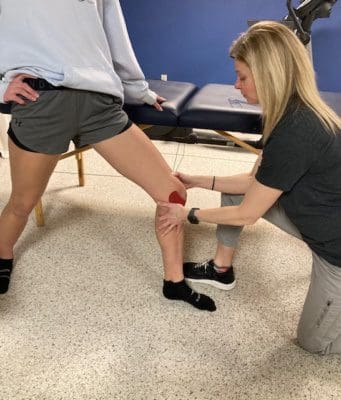
Signs indicating you may need professional help (a P.T., chiropractor, MD, DO, or massage therapist):
-sharp, stabbing pain that worsens with activity
-instability/giving out
-numbness or tingling that comes on during activity and hangs around even after stopping
-pain that is worse at night or with static positions (driving, sitting for long periods of time, etc.)
-swelling that does not go away with compression/elevation/rest/anti-inflammatories
-pain that does not improve with rest
Yeah, but can I keep running?
-If you feel the pain when you start the run and it doesn’t worsen or even gets better, then, yes, you can run. You may need to adjust the purpose of the run (easy run instead of intervals), but usually you can run without doing damage.
-If the pain is there throughout the run but stays below a 3 or 4 on a 0-10 pain scale, you can usually run without doing damage. If over time it is gradually getting worse, then it’s time to stop.
-If you can run and not pay for it the rest of the day, you can usually keep running. If it’s okay during the run yet painful after the run, it’s time to think about finding help.
-If it’s been 2+ weeks, and it is still bothering you during a run or after, it’s time to get it checked!
Remember, no running injury is ever made better by ignoring it and continuing to run. (Trust us. We’ve tried.) But the sooner you address the underlying issues and fix the problem, the sooner you can get back out there pain free!



Love this new series! This first question especially hit home. On Xmas day I was out on a run and seemingly all of a sudden got intense tightness from my knee to up my hamstring. Nothing seems to happen but I have not been able to run since. I have sought out help from a PT, massage therapist, and my trainer. It is getting better….slowly. A few weeks ago I thought it was well enough to go for my usual morning 3 milers with my BRF – I totally paid for it the rest of the day. And that really set me back physically and mentally to be honest. I am now unsure of when and how to try to give running a try again. How many weeks should I be pain free? Should I start with run / walk intervals? An easy mile around the block? I just have a bit of stage fright after blowing up the last time I tried.
So sorry you are going thru this Cortney! My suggestion would be to start with run/walk intervals and to start with 1-1.5 miles. If that goes well you can either keep the run/walk intervals and do more overall time (adding 5 min or so each outing) or lengthening the run interval (going from 60 sec to 2 minutes). When to start? As long as you are not having pain with walking, you could start. And if you stall out or have more pain at any step, drop back down a step. There is nothing wrong with doing the same run/walk intervals for the same amount of total time a 2-3x a week and then trying to bump up after a week with no worsening or no pain (a little pain would be somewhat expected if starting over after a several week layoff but it should go away after a day or two). Good luck!
I have knee pain and I’ve become “debilitated” in who to go to to have it looked at. Part of me thinks it’s from my shoes and running gait. PT? Orthopedic doctor? Dry needling? My chiro who doesn’t “crack” you but uses dry needling and the Activator Methods technique? I’d really like to have someone do a running gait analysis but I can’t even figure out who would do that. In addition every time I think I’ve found a PT that should specialize in running, they don’t end up being that. I think the pain is stemming from ankles or hips. Ahhhhhhh! I’m so frustrated with not knowing of where to even start with getting it looked at. Thank you!
Hey Kristine, totally understand your frustration. There is a WIDE variety of of PTs and PT backgrounds, so it definitely makes it hard to know where to go. That being said, I still would default to a PT (but hopefully one who actually runs or has run in the past as they will be a bit more open to runner people brains :)) as they tend to look at things from a whole body perspective vs. just the knee. Especially since knee pain can have so many causes other than JUST the knee! In looking for a PT, ask lots of questions when scheduling. It might help get things narrowed down to someone that can really help you! That being said, your chiro sounds like he would have a good perspective as well, so maybe starting there and just being vocal about what you are looking for and what you need. (ie. please look at the whole lower body chain!). Depending on your insurance, the orthopedic dr may be needed to get you in to PT, but most of the time that is not necessary with longer term issues (so saving you some time and $$). Good luck!