
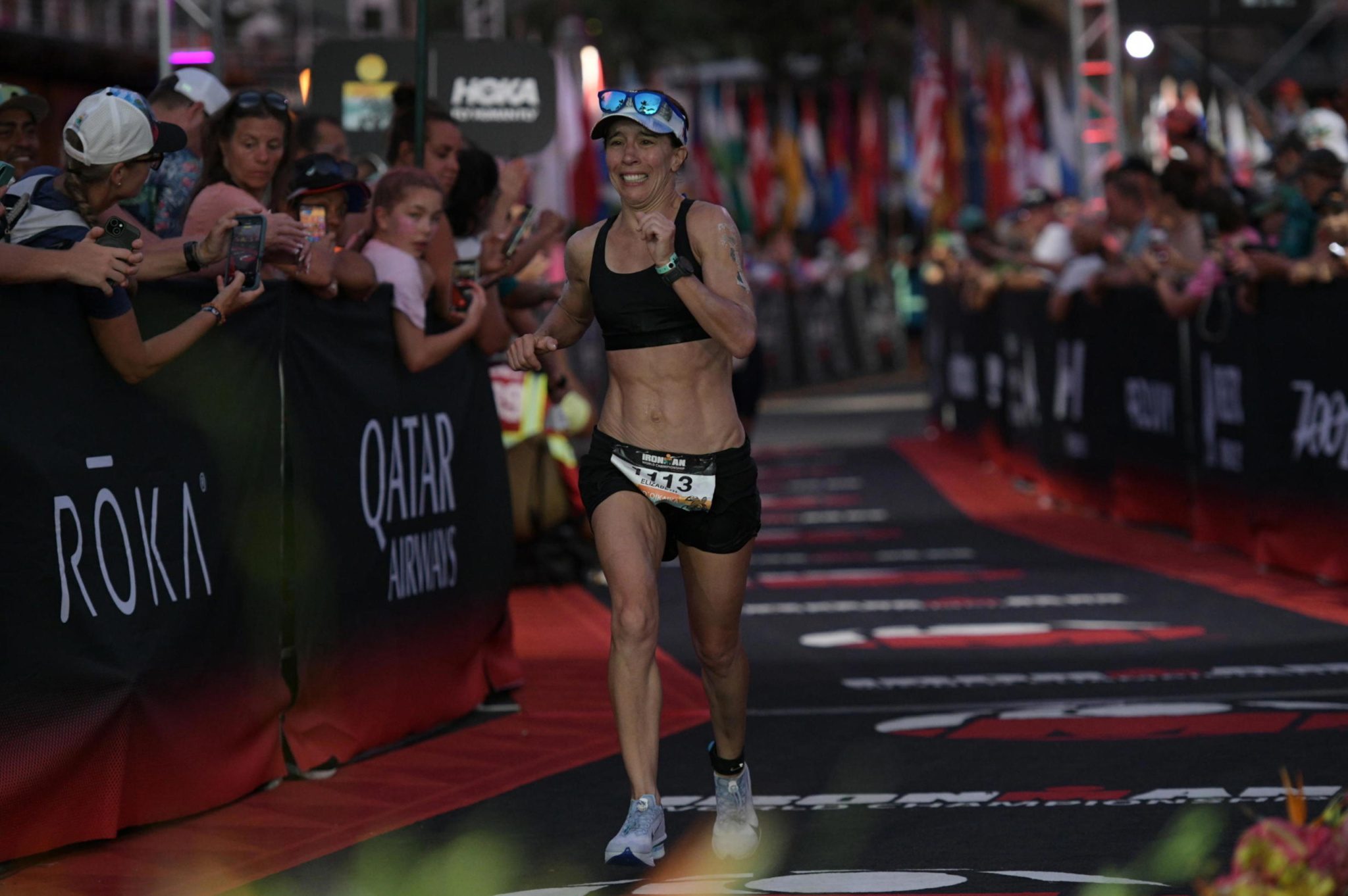
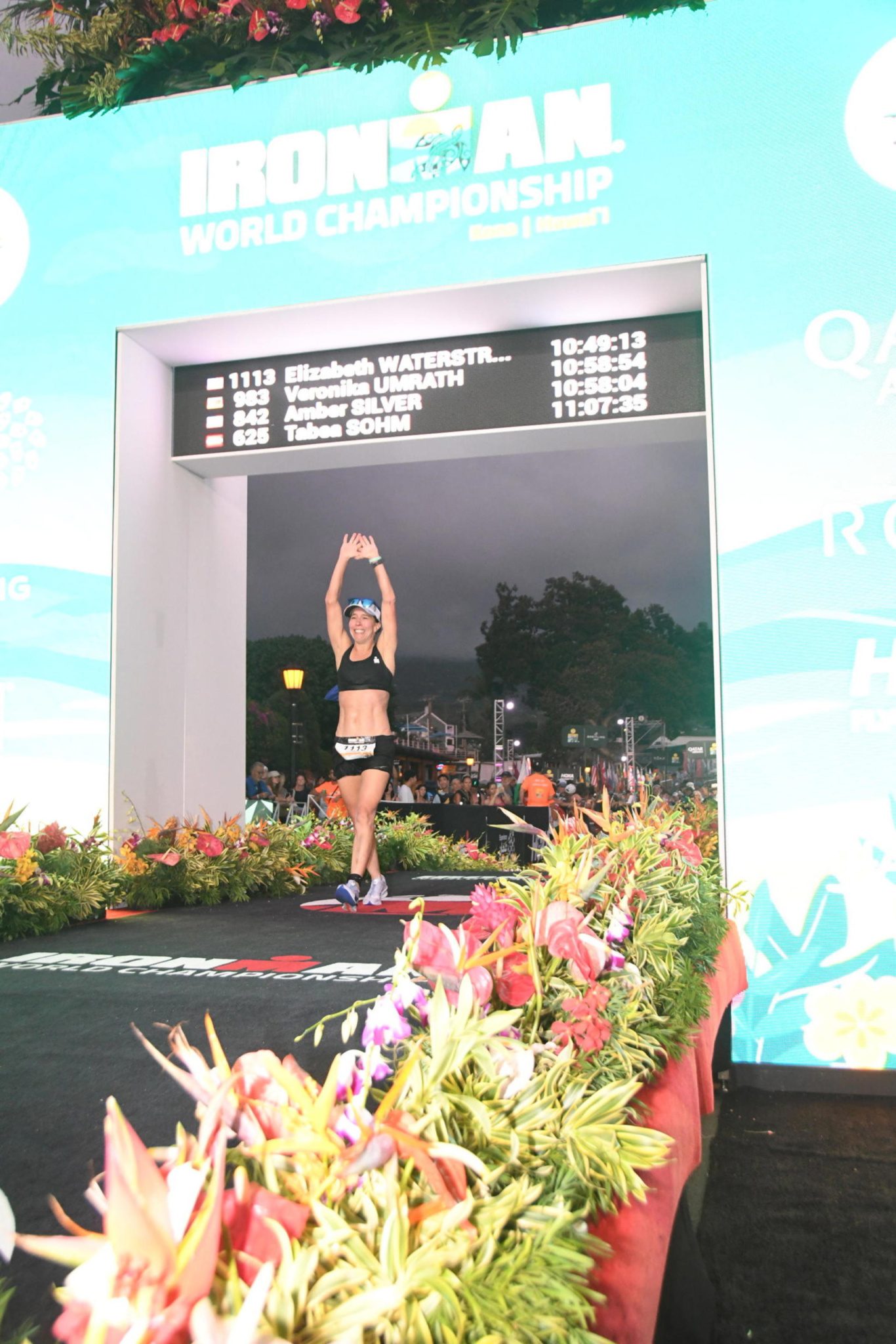
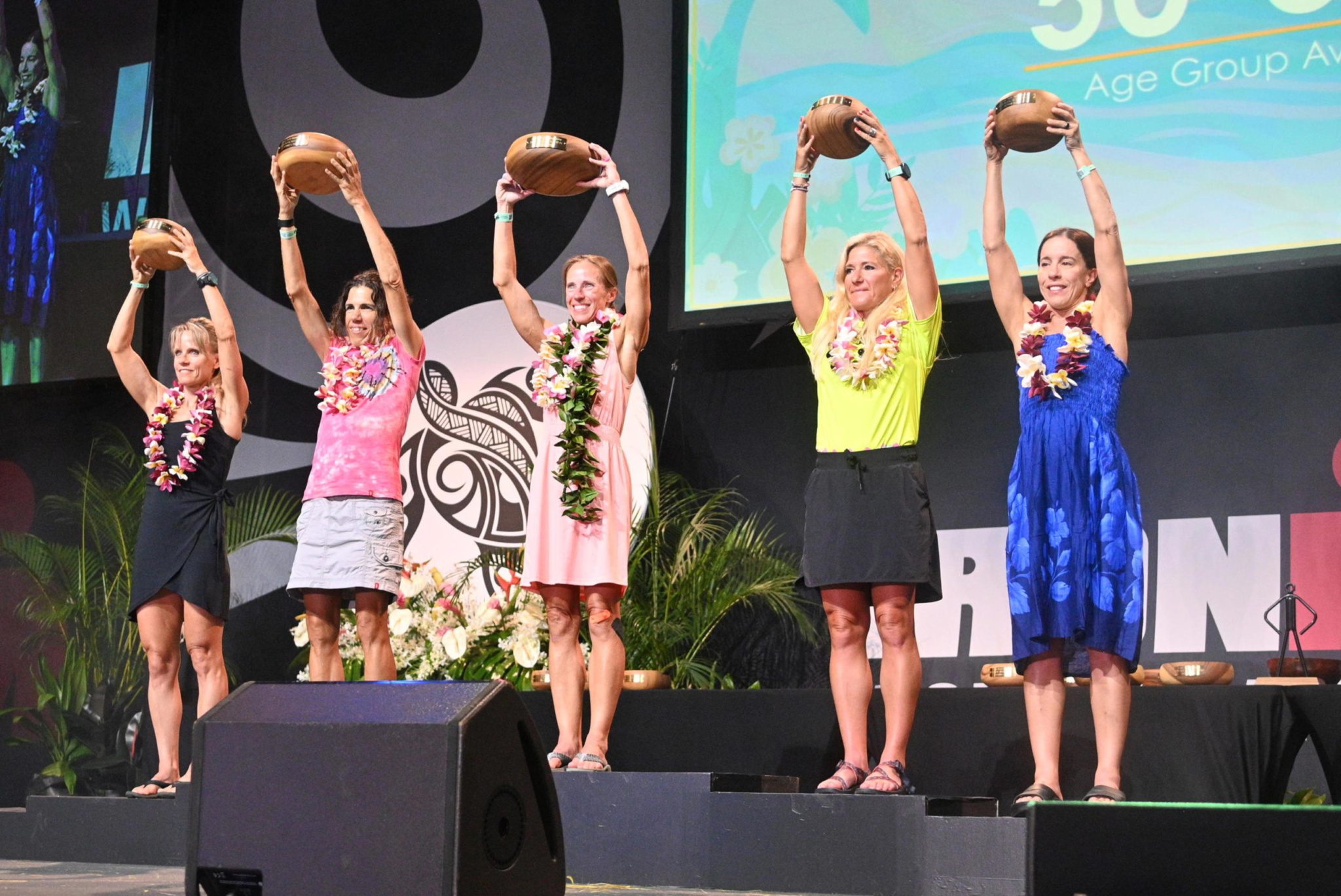
On Saturday, October 11, Liz Waterstraat, one of our podcast hosts (including Miles of Books, Non-Fiction!) and a coach in our Train Like a Mother Club, showed us what it means to dig deep and execute a brilliant race at the Ironman World Championship in Kona, Hawaii. Liz finished 5th in her age group (50-54). We needed the details, so here’s a Q&A with our very own Ironman idol.
How did your body feel competing at Kona?
I arrived at the start line very fit and healthy—and at 50, that is not lost on me. I made a lot of changes to my daily eating and habits this year and both propelled me to a higher level of health, freshness, and performance than I’ve seen in the past.
My training was incredibly consistent: I put in some of the biggest training weeks I’ve ever done to improve my durability and resilience. During the race, I felt amazing—best I’ve ever felt in an Ironman. [This was her 6th IM triathlon.] Of course Ironman is a long and hard day but at no point did my body feel under pressure or unable to rise up to the demands of the day. How I felt has inspired me to consider if I can go even faster!
What were your goals for the race—time goals, AG-placing goals, overall-finisher goals?
Six months ago, I told my coach that my goal was to go Kona and have my best race—I did not attach any time or placement goals to that (because the outcome is never in my control and never the point—the point, to me, is who I become in the process, what I learn, and how I grow). I knew if I deeply committed and brought the best version of myself to every day’s training, I would be in a position to race my best race possible.
How would you rank your strengths in triathlon: swim, bike, run, and transitions? And does your finish placement in each discipline match what you believe your strengths are, or were there surprises for you on the course?
Many people kindly said, “congrats, and especially on your run!”—yet to arrive at the run ready to do something special I knew I needed tremendous swim and bike strength, fitness, and pacing. Ironman is a patience game. So my plan for the swim was to swim at an effort that allowed me to get out of the water feeling like I didn’t swim. The bike was an exercise in eating, drinking, and patience. The run was a byproduct of making good choices all day.
On a podcast, you once casually let it drop that you’ve done “only” one stand-alone marathon. How the heck do you run so strong and stay so mentally tough in the 26.2-portion of an Ironman?
Running well over the distance requires a lot of durability. Nothing replaces getting in the miles—at the right heart rate and appropriate intensity. Most of my running was quite easy, at a pace 30 to 60 seconds per mile slower than race day. Once a week I did some longer intervals at a very controlled pace. By running frequently and managing intensity, I was able to run more and more consistently—which is the foundation for robust fitness.
Mentally, on race day, I just went to the place I went in training. I had listened to an interview of John John Florence, a highly accomplished surfer, about how he hones his mental game. Instead of visualizing actions, he visualizes how he wants to feel on competition day. On every run, I would take a moment to ask myself, “How do you want to feel?” and I would say the words aloud to myself. Words that kept coming up were: strong, capable, grateful. I envisioned running with those feelings. On race day, I did the same.
I also was really, really excited to run. Many athletes go into their events with fear or constriction. I saw the run as an entire playground where I got to express the best version of myself. I smiled. I cheered on my competitors. I took in my surroundings. I stayed present. If there’s a flow state, I was in it. I had so much fun running.
Heard it was a hot day in Kona. Did you use some of the strategies from your scorching 70.3 this summer that you talked about on the podcast?
Yes—and no. Rockford 70.3 was in June—and at that time we had limited exposure to warmer temperatures.
With Kona being in October, we had a very hot summer in Chicago, and even a few bonus weeks into September. Temperatures were still in the upper 80s when I left for the Big Island. I was able to hold on to solid heat acclimation. I also did specific acclimation sessions indoors in September. Both left me feeling as prepared as possible for Kona conditions.
After the race, I was surprised to hear commentators call the conditions ‘brutal’ and ‘humid.’ On race day, I did not feel intense heat or humidity. I tried to race as patiently, as smoothly, and calmly as possible to minimize building up heat. Again, I really held back on the swim (the water was 81.5 degrees) and on the bike (we had a lot of tailwind for the first 40 miles so there was a higher risk of early overheating).
On a recent episode of Miles of Books (MOB), you talked about creativity. Did you summon any creativity on the course in Hawaii?
There were many creative shifts on race day! Ironman requires a lot of problem solving and flexibility. In Kona, the aid stations sometimes had gels with 25g of carbs, and other times 40g. I had to do some quick calculations and changes to be sure I was meeting my targets. I also heard I got off the bike 25th in my age group: Rather than fretting about an ‘impossible’ task ahead of me, I switched perspective to an opportunity to ‘run down’ as many women as possible to see what happens.
And how about curiosity—that’s another biggie you often talk about on MOB?
I tapped into curiosity around Mile 21 when my friend Steve told me I was 4 minutes from 5th place. Mile 21 is when the miles can really wear on you along the Queen K— it’s been a long day; your quads are barking. Instead of giving in, I chose to get curious about if I could pick up the pace’ if I could ‘win’ the aid stations; if I could run myself on to the podium (5th place).
What do you know now that you wish you could tell first-time Ironman competitor Liz?
I would go back and repeat what my friend Marshall told first-time competitor Liz before her first Ironman: ‘You get to do everything you love to do for an entire day.’ It’s not a ‘have to’ but a ‘get to.’ An opportunity. When I wrote my race plan for myself before Kona, I told myself that if I just focused on going out there to have fun doing what I love to do (swimming, biking, and running all day), I’d have my best race.
How motivational or energizing is it to have Coach Jen along supporting you—and how many directives does she yell to you on the course?
Jen is a world-class friend and ‘handler’ (as we call it). At Mile 25, Jen was on the side of the road and said, ‘Don’t cry: You just ran into 5th place, but she’s still 40 seconds behind you.’ If she hadn’t been there, I might have let up in the last mile and gotten passed; instead, I was able to pull ahead by more than 90 seconds. She delivered an impeccably timed message that allowed me to fully realize a dream—the age group podium at the Ironman World Championship.

Think you’ll ever race at Kona again?
I turned 50 this year, and I grounded my year in this question: What if I could get faster? I went all in and committed to deconstruct the limitations we feel and assumptions we make as aging women.
I had a magical race. And while this race in Kona feels complete, there’s a part of me that is still curious, still asking questions. What else is possible? What if you can go even faster? The race inspired me to make a list of athletic things I still have not achieved—on paper, they are wild, outlandish. But why not me? Why not after 50? And so while before the race I may have said ‘no,’ now I’ll offer a strong ‘maybe’ to honor that part of myself that is always curious and always learning.

DO all those things you have written down- many I wish I was 50 again!!! I still have what some may call “outlandish” goals turning 72 last month…but I have always loved the routine, the early dark mornings being out there alone ( or with hubby) and the schedule and ALL THE WORKOUTS! YES you GET to! I am going on three years following my brain tumor surgery which left me totally deaf in one ear and I am still grappling with balance and equilibrium. I also had a hip replacement. I ran/waled 3.5 miles this morning at 5:15 and it made me SO happy to be able to just get out there, see the stars, some lightning in the distance and watch the sun rise once again. My goal is to get back onto bumpy rocky ground , which messes with my damaged vestibular system because of the tumor. Goal: retrain the brain/body so that I am able to feel comfortable again on loose rocks/uneven terrain. You rock…and so glad you had that magical race everyone hopes for.. so wonderful. Hordes of congratulations to you and love the mindset! Life rushes by so quickly.. keep doing what you love! :-)
[…] Before Tom joins the conversation around 8:00, Coach Liz talks about the mindset she brought to her Ironman training this year—and how it carried her to success (+ enjoyment!) on race day. […]